2.6.4
Isolation Forest
Summary
- Isolation Forest isolates points through random partitioning trees and uses short path lengths as anomaly evidence.
rn- It makes weak distributional assumptions and scales well to high-dimensional settings.rn-contaminationand tree settings control detection sensitivity and practical alert volume.
Intuition #
Anomalies are easier to isolate than normal points. Isolation Forest quantifies this by averaging how quickly samples get separated across many random trees.
Detailed Explanation #
1. How it works #
- Randomly subsample the data.
- Build Isolation Trees by splitting on randomly chosen features and thresholds.
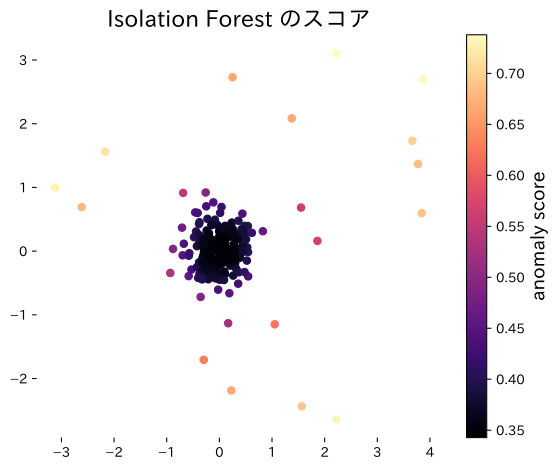
- Samples with shorter average path length are easier to isolate, so they are more likely to be anomalies.
The anomaly score is normalized using the expected path length of a random binary search tree, \(c(n)\), and the observed average path length.
2. Python example #
| |
3. Hyperparameters #
n_estimators: Number of trees. More trees give stabler results.max_samples: Samples used per tree. Default ismin(256, n_samples).contamination: Estimated fraction of anomalies; used to set the threshold.max_features: Features used at each split.
4. Pros and cons #
| Pros | Cons |
|---|---|
| Relatively fast even in high dimensions | Results can vary with the random seed |
| Scaling is not required (but recommended) | Small local anomalies may be missed |
| Simple training and inference | contamination can be hard to set |
5. Summary #
- Isolation Forest is a tree-based anomaly detector that uses short isolation paths as the anomaly signal.
- It is easy to use in scikit-learn, mainly tuning the number of trees and samples.
- It is a good fit when you need fast candidate filtering for logs or sensor data.