Regresión Partial Least Squares (PLS)

2.1.9

Regresión Partial Least Squares (PLS)

Actualizado 2020-05-20 Lectura 4 min
Resumen
  • PLS extrae factores latentes que maximizan la covarianza entre predictores y objetivo antes de realizar la regresión.
  • A diferencia de PCA, los ejes aprendidos incorporan información de la variable objetivo, manteniendo el desempeño predictivo mientras se reduce la dimensionalidad.
  • Ajustar el número de factores latentes estabiliza el modelo cuando existe fuerte multicolinealidad.
  • Analizar los loadings permite identificar qué combinaciones de características se relacionan más con la variable objetivo.

Intuicion #

Este metodo se entiende mejor al conectar sus supuestos con la estructura de los datos y su efecto en la generalizacion.

Explicacion Detallada #

Formulación matemática #

Dado un matriz de predictores \(\mathbf{X}\) y un vector objetivo \(\mathbf{y}\), PLS alterna las actualizaciones de las puntuaciones latentes \(\mathbf{t} = \mathbf{X} \mathbf{w}\) y \(\mathbf{u} = \mathbf{y} c\) de forma que la covarianza \(\mathbf{t}^\top \mathbf{u}\) sea máxima. Repetir el proceso produce un conjunto de factores latentes sobre el que se ajusta un modelo lineal

$$ \hat{y} = \mathbf{t} \boldsymbol{b} + b_0. $$

El número de factores \(k\) suele elegirse mediante validación cruzada.

Experimentos con Python #

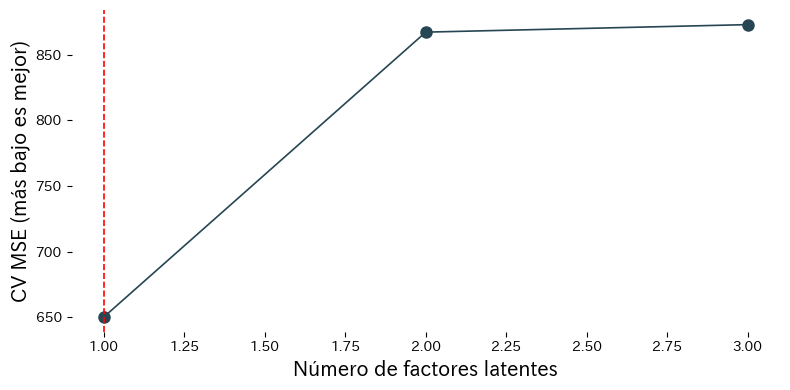
Comparamos el desempeño de PLS para distintos números de factores latentes con el conjunto de datos de acondicionamiento físico de Linnerud.

 1
 2
 3
 4
 5
 6
 7
 8
 9
10
11
12
13
14
15
16
17
18
19
20
21
22
23
24
25
26
27
28
29
30
31
32
33
34
35
36
37
38
39
40
41
42
43
44
45
46
47
48
49
50
51
52
53
54
55
56
57
58
59
60
61
62
63
64
65
66
67
68
69
70
71
72
73
74
75
76
77
78
79
80
81
82
83
84
85
86
87
88
89
90
91
92
93
94
95
from __future__ import annotations

import japanize_matplotlib
import matplotlib.pyplot as plt
import numpy as np
from sklearn.cross_decomposition import PLSRegression
from sklearn.datasets import load_linnerud
from sklearn.model_selection import KFold, cross_val_score
from sklearn.pipeline import Pipeline
from sklearn.preprocessing import StandardScaler

def evaluate_pls_latent_factors(
    cv_splits: int = 5,
    xlabel: str = "Number of latent factors",
    ylabel: str = "CV MSE (lower is better)",
    label_best: str = "best={k}",
    title: str | None = None,
) -> dict[str, object]:
    """Cross-validate PLS regression for different latent factor counts.

    Args:
        cv_splits: Number of folds for cross-validation.
        xlabel: Label for the number-of-factors axis.
        ylabel: Label for the cross-validation error axis.
        label_best: Format string for the best-factor annotation.
        title: Optional plot title.

    Returns:
        Dictionary with the selected factor count, CV score, and loadings.
    """
    japanize_matplotlib.japanize()
    data = load_linnerud()
    X = data["data"]
    y = data["target"][:, 0]

    max_components = min(X.shape[1], 6)
    components = np.arange(1, max_components + 1)
    cv = KFold(n_splits=cv_splits, shuffle=True, random_state=0)

    scores = []
    pipelines = []
    for k in components:
        model = Pipeline([
            ("scale", StandardScaler()),
            ("pls", PLSRegression(n_components=int(k))),
        ])
        cv_score = cross_val_score(
            model,
            X,
            y,
            cv=cv,
            scoring="neg_mean_squared_error",
        ).mean()
        scores.append(cv_score)
        pipelines.append(model)

    scores_arr = np.array(scores)
    best_idx = int(np.argmax(scores_arr))
    best_k = int(components[best_idx])
    best_mse = float(-scores_arr[best_idx])

    best_model = pipelines[best_idx].fit(X, y)
    x_loadings = best_model["pls"].x_loadings_
    y_loadings = best_model["pls"].y_loadings_

    fig, ax = plt.subplots(figsize=(8, 4))
    ax.plot(components, -scores_arr, marker="o")
    ax.axvline(best_k, color="red", linestyle="--", label=label_best.format(k=best_k))
    ax.set_xlabel(xlabel)
    ax.set_ylabel(ylabel)
    if title:
        ax.set_title(title)
    ax.legend()
    fig.tight_layout()
    plt.show()

    return {
        "best_k": best_k,
        "best_mse": best_mse,
        "x_loadings": x_loadings,
        "y_loadings": y_loadings,
    }

metrics = evaluate_pls_latent_factors(
    xlabel="Número de factores latentes",
    ylabel="MSE de CV (más bajo es mejor)",
    label_best="mejor k={k}",
    title="Selección de factores en PLS",
)
print(f"Mejor número de factores: {metrics['best_k']}")
print(f"Mejor MSE de CV: {metrics['best_mse']:.3f}")
print("Cargas de X:
", metrics['x_loadings'])
print("Cargas de Y:
", metrics['y_loadings'])

Comparamos el desempeño de PLS para distintos números de fac… (figura)

Interpretación de los resultados #

  • El MSE de validación cruzada desciende al añadir factores, alcanza un mínimo y luego empeora si seguimos agregando más.
  • Inspeccionar x_loadings_ y y_loadings_ muestra qué características contribuyen más a cada factor latente.
  • Estandarizar las entradas garantiza que características con diferentes escalas aporten de manera equilibrada.

Referencias #

  • Wold, H. (1975). Soft Modelling by Latent Variables: The Non-Linear Iterative Partial Least Squares (NIPALS) Approach. En Perspectives in Probability and Statistics. Academic Press.
  • Geladi, P., & Kowalski, B. R. (1986). Partial Least-Squares Regression: A Tutorial. Analytica Chimica Acta, 185, 1–17.