X-means

2.5.3

X-means

อัปเดต 2020-02-26 อ่าน 4 นาที
สรุป
  • X-means เป็นส่วนขยายของ K-means ที่ประเมินการแยกคลัสเตอร์ด้วยเกณฑ์ BIC/MDL เพื่อประมาณจำนวนคลัสเตอร์อัตโนมัติ.
  • การกำหนดจำนวนคลัสเตอร์ขั้นต่ำและสูงสุดช่วยจำกัดช่วงค้นหาและลดปัญหาแบ่งคลัสเตอร์มากเกินไป.
  • การเปรียบเทียบกับ K-means แบบกำหนด k คงที่ช่วยเห็นผลของการเลือกจำนวนคลัสเตอร์ต่อการตีความข้อมูล.

สัญชาตญาณ #

X-means ใช้แนวคิดแบ่งแล้วทดสอบ เริ่มจากคลัสเตอร์หยาบก่อน แล้วจะแบ่งเพิ่มเฉพาะกรณีที่เกณฑ์สถิติชี้ว่าดีขึ้น วิธีนี้ลดการเดา k ด้วยมือและยังควบคุมความซับซ้อนได้ดี.

คำอธิบายโดยละเอียด #

X-means | ประมาณจำนวนคลัสเตอร์อัตโนมัติ #

สรุป
  • X-means ขยาย k-means ให้เลือกจำนวนคลัสเตอร์เองโดยลองแบ่งคลัสเตอร์ย่อยตามความจำเป็น
  • เมื่อแบ่งคลัสเตอร์หนึ่งเป็นสอง จะคำนวณเกณฑ์ BIC/MDL หากค่าดีขึ้นจึงยอมรับการแบ่ง
  • สามารถเขียนเวอร์ชันง่ายๆ ได้ด้วยการรัน k-means และคำนวณ BIC ด้วยตัวเอง ไม่จำเป็นต้องมีไลบรารีเฉพาะ
  • เหมาะกับสถานการณ์ที่กำหนด \(k\) ล่วงหน้าได้ยาก เพราะปล่อยให้ข้อมูลชี้นำจำนวนกลุ่มที่เหมาะสม

ภาพรวมเชิงสัญชาติญาณ #

k-means ต้องระบุ \(k\) ล่วงหน้า X-means แก้ด้วยการเริ่มจาก \(k\) เล็กๆ แล้วตรวจทุกคลัสเตอร์ว่าสมควรแบ่งต่อหรือไม่: ถ้าแบ่งแล้ว BIC ดีขึ้นก็เก็บทั้งสองคลัสเตอร์ใหม่ไว้พิจารณาต่อ เมื่อไม่มีคลัสเตอร์ไหนควรแบ่ง ตัวเลข \(k\) ก็ถูกกำหนดอัตโนมัติ

สูตรสำคัญ #

ให้คลัสเตอร์ \({C_1,\ldots,C_k}\) กับศูนย์กลาง \({\mu_j}\) BIC สำหรับโมเดลหนึ่งคำนวณได้จาก

$$ \mathrm{BIC} = \ln L - \tfrac{p}{2} \ln n, $$

โดย \(L\) คือ likelihood, \(p\) จำนวนพารามิเตอร์ และ \(n\) จำนวนตัวอย่าง ถ้า BIC หลังแบ่งใหญ่กว่าแสดงว่าโมเดลใหม่ดีกว่า เราจึงยอมรับการแบ่งนั้น

ทดลองด้วย Python #

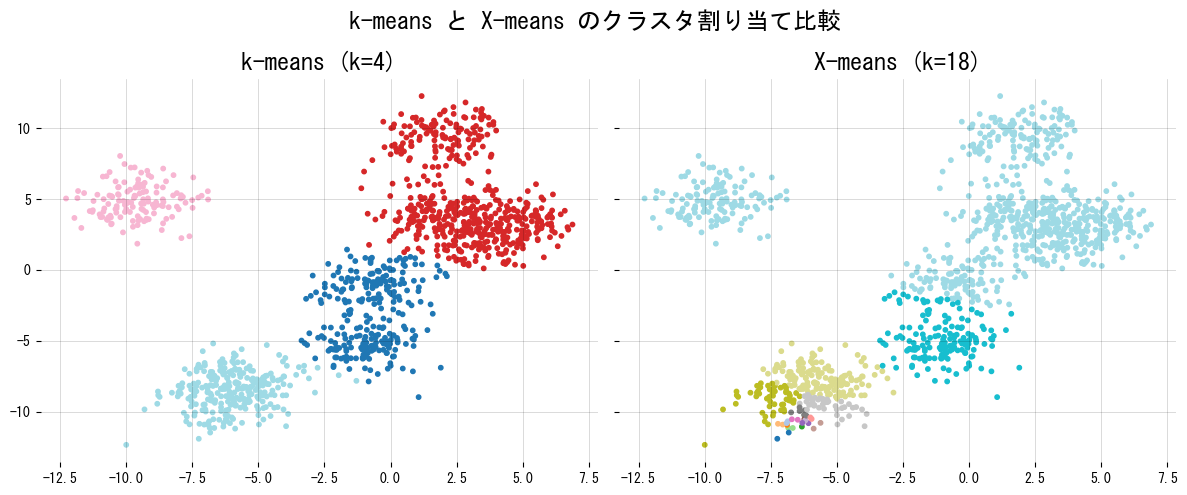
โค้ดต่อไปนี้สร้างเวอร์ชันอย่างง่ายของ X-means และเปรียบเทียบกับ k-means ที่ตั้ง \(k=4\) คงที่

  1
  2
  3
  4
  5
  6
  7
  8
  9
 10
 11
 12
 13
 14
 15
 16
 17
 18
 19
 20
 21
 22
 23
 24
 25
 26
 27
 28
 29
 30
 31
 32
 33
 34
 35
 36
 37
 38
 39
 40
 41
 42
 43
 44
 45
 46
 47
 48
 49
 50
 51
 52
 53
 54
 55
 56
 57
 58
 59
 60
 61
 62
 63
 64
 65
 66
 67
 68
 69
 70
 71
 72
 73
 74
 75
 76
 77
 78
 79
 80
 81
 82
 83
 84
 85
 86
 87
 88
 89
 90
 91
 92
 93
 94
 95
 96
 97
 98
 99
100
101
102
103
104
105
106
107
108
109
110
111
112
113
114
115
116
117
118
119
120
121
122
123
124
125
126
127
128
129
130
131
132
from __future__ import annotations

import matplotlib.pyplot as plt
import numpy as np
from numpy.typing import NDArray
from sklearn.cluster import KMeans
from sklearn.datasets import make_blobs

def generate_dataset(
    n_samples: int = 1200,
    n_centers: int = 9,
    cluster_std: float = 1.1,
    random_state: int = 1707,
) -> NDArray[np.float64]:
    features, _ = make_blobs(
        n_samples=n_samples,
        centers=n_centers,
        cluster_std=cluster_std,
        random_state=random_state,
    )
    return features

def compute_bic(
    data: NDArray[np.float64],
    labels: NDArray[np.int64],
    centers: NDArray[np.float64],
) -> float:
    """คำนวณ BIC สำหรับผลลัพธ์ของ k-means"""
    n_samples, n_features = data.shape
    n_clusters = centers.shape[0]
    cluster_sizes = np.bincount(labels, minlength=n_clusters)
    sse = 0.0
    for idx, center in enumerate(centers):
        if cluster_sizes[idx] == 0:
            continue
        diffs = data[labels == idx] - center
        sse += float((diffs**2).sum())

    variance = sse / max(n_samples - n_clusters, 1)
    variance = max(variance, 1e-6)

    log_likelihood = 0.0
    norm_const = -0.5 * n_features * np.log(2 * np.pi * variance)
    for size in cluster_sizes:
        if size > 0:
            log_likelihood += size * norm_const - 0.5 * (size - 1)

    n_params = n_clusters * (n_features + 1)
    bic = log_likelihood - 0.5 * n_params * np.log(n_samples)
    return float(bic)

def xmeans_split(
    data: NDArray[np.float64],
    k_max: int = 20,
    random_state: int = 42,
) -> NDArray[np.int64]:
    """X-means อย่างง่าย: แยกคลัสเตอร์เมื่อ BIC ดีขึ้น"""
    rng = np.random.default_rng(random_state)
    pending = [np.arange(len(data))]
    accepted: list[NDArray[np.int64]] = []

    while pending:
        indices = pending.pop()
        subset = data[indices]

        if len(indices) <= 2:
            accepted.append(indices)
            continue

        parent_labels = np.zeros(len(indices), dtype=int)
        parent_center = subset.mean(axis=0, keepdims=True)
        bic_parent = compute_bic(subset, parent_labels, parent_center)

        split_model = KMeans(
            n_clusters=2,
            n_init=10,
            max_iter=200,
            random_state=rng.integers(0, 1_000_000),
        ).fit(subset)
        bic_children = compute_bic(subset, split_model.labels_, split_model.cluster_centers_)

        if bic_children > bic_parent and (len(accepted) + len(pending) + 1) < k_max:
            pending.append(indices[split_model.labels_ == 0])
            pending.append(indices[split_model.labels_ == 1])
        else:
            accepted.append(indices)

    labels = np.empty(len(data), dtype=int)
    for cluster_id, cluster_indices in enumerate(accepted):
        labels[cluster_indices] = cluster_id
    return labels

def run_xmeans_demo(
    random_state: int = 2024,
    initial_k: int = 4,
    k_max: int = 18,
) -> dict[str, object]:
    """เปรียบเทียบ k-means ธรรมดากับ X-means"""
    data = generate_dataset(random_state=random_state)

    kmeans_labels = KMeans(
        n_clusters=initial_k,
        n_init=10,
        random_state=random_state,
    ).fit_predict(data)
    xmeans_labels = xmeans_split(data, k_max=k_max, random_state=random_state + 99)

    unique_xmeans = np.unique(xmeans_labels)

    fig, axes = plt.subplots(1, 2, figsize=(12, 5), sharex=True, sharey=True)
    axes[0].scatter(data[:, 0], data[:, 1], c=kmeans_labels, cmap="tab20", s=10)
    axes[0].set_title(f"k-means (k={initial_k})")
    axes[0].grid(alpha=0.2)

    axes[1].scatter(data[:, 0], data[:, 1], c=xmeans_labels, cmap="tab20", s=10)
    axes[1].set_title(f"X-means (k={len(unique_xmeans)})")
    axes[1].grid(alpha=0.2)

    fig.suptitle("เปรียบเทียบผลการจัดกลุ่มของ k-means และ X-means")
    fig.tight_layout()
    plt.show()

    return {
        "kmeans_clusters": int(initial_k),
        "xmeans_clusters": int(len(unique_xmeans)),
        "cluster_sizes": np.bincount(xmeans_labels).tolist(),
    }

results = run_xmeans_demo()
print(f"k-means ใช้ k = {results['kmeans_clusters']}")
print(f"X-means ประมาณ k = {results['xmeans_clusters']}")
print(f"ขนาดคลัสเตอร์ของ X-means: {results['cluster_sizes']}")

เปรียบเทียบ k-means กับ X-means

เอกสารอ้างอิง #

  • Pelleg, D., & Moore, A. W. (2000). X-means: Extending k-means with Efficient Estimation of the Number of Clusters. ICML.
  • Bahmani, B., Moseley, B., Vattani, A., Kumar, R., & Vassilvitskii, S. (2012). Scalable k-means++. VLDB.
  • scikit-learn developers. (2024). Clustering. https://scikit-learn.org/stable/modules/clustering.html