1
 2
 3
 4
 5
 6
 7
 8
 9
10
11
12
13
14
15
16
17
18
19
20
21
22
23
24
25
26
27
28
29
30
31
32
33
34
35
36
37
38
39
40
41
42
43
44
45
46
47
48
49
50
51
52
53
54
55
56
57
58
59
60
61
62
63
64
65
66
67
68
69
70
71
72
73
74
75
76
77
78
79
80
81
82
83
84
85
86
87
88
89
90
91
92
93
94
95
96
97
98
99
100
101
102
103
104
105
106
107
108
| import warnings
from statsmodels.tsa.holtwinters import ExponentialSmoothing, SimpleExpSmoothing
from statsmodels.tsa.arima.model import ARIMA
warnings.filterwarnings("ignore")
def compute_mase(actual, predicted, train, m=12):
e = np.abs(actual - predicted)
scale = np.abs(train.values[m:] - train.values[:-m]).mean()
return e.mean() / scale if scale > 0 else np.nan
def croston_forecast(train, h, alpha=0.1):
"""Croston法: 需要間隔と需要サイズを分離してSES。"""
vals = train.values
# 需要発生時点を抽出
demand_idx = np.where(vals > 0)[0]
if len(demand_idx) < 2:
mean_demand = vals[vals > 0].mean() if (vals > 0).any() else 0
return np.full(h, mean_demand)
# 需要サイズ
sizes = vals[demand_idx]
# 需要間隔(発生間の期間数)
intervals = np.diff(demand_idx).astype(float)
# SESで平滑化
z = sizes[1:] # 最初のサイズは間隔と対応しないので除く
p = intervals
z_hat = z[0]
p_hat = p[0]
for j in range(1, len(z)):
z_hat = alpha * z[j] + (1 - alpha) * z_hat
p_hat = alpha * p[j] + (1 - alpha) * p_hat
# 予測: 需要サイズ / 需要間隔 = 期待需要/期
forecast_value = z_hat / p_hat if p_hat > 0 else 0
return np.full(h, forecast_value)
results = {}
# 季節ナイーブ
last12 = train_raw.values[-12:]
results["季節ナイーブ"] = np.tile(last12, int(np.ceil(h / 12)))[:h]
# SES
try:
results["SES"] = SimpleExpSmoothing(
train_raw, initialization_method="estimated"
).fit().forecast(h).values
except Exception:
results["SES"] = np.full(h, np.nan)
# HW加法
try:
results["HW加法"] = ExponentialSmoothing(
train_raw, trend="add", seasonal=None,
initialization_method="estimated",
).fit().forecast(h).values
except Exception:
results["HW加法"] = np.full(h, np.nan)
# ARIMA(1,0,0)
try:
results["ARIMA"] = ARIMA(train_raw, order=(1, 0, 0)).fit().forecast(steps=h).values
except Exception:
results["ARIMA"] = np.full(h, np.nan)
# Croston法
results["Croston"] = croston_forecast(train_raw, h, alpha=0.1)
# MASE + RMSE
metrics = {}
for name, pred in results.items():
mase = compute_mase(test_raw.values, pred, train_raw, m=12)
rmse = np.sqrt(np.mean((test_raw.values - pred) ** 2))
metrics[name] = {"MASE": mase, "RMSE": rmse}
# 棒グラフ
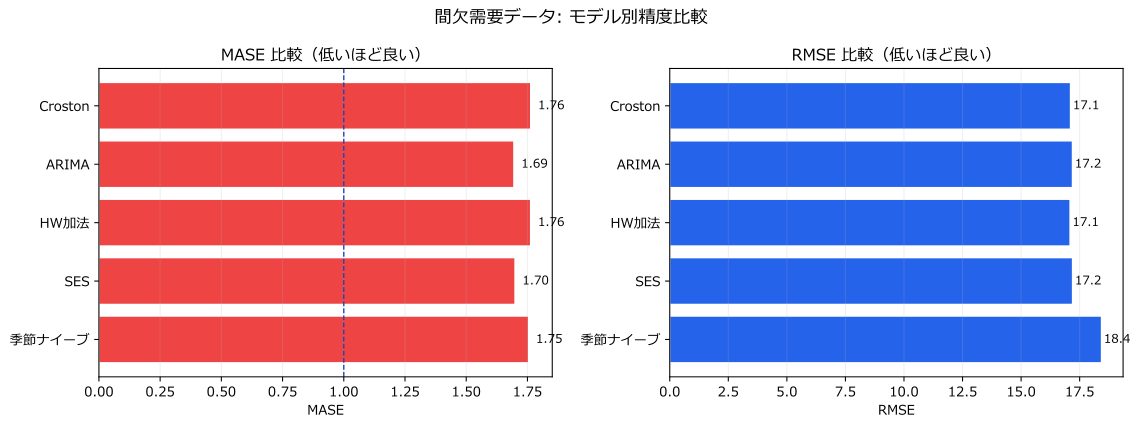
names = list(metrics.keys())
mase_vals = [metrics[n]["MASE"] for n in names]
rmse_vals = [metrics[n]["RMSE"] for n in names]
fig, axes = plt.subplots(1, 2, figsize=(12, 4.5))
colors = ["#10b981" if v < 1 else "#ef4444" for v in mase_vals]
bars = axes[0].barh(names, mase_vals, color=colors, edgecolor="white")
axes[0].axvline(1.0, color="#1e40af", linestyle="--", linewidth=1)
axes[0].set_xlabel("MASE")
axes[0].set_title("MASE 比較(低いほど良い)")
for bar, v in zip(bars, mase_vals):
if not np.isnan(v):
axes[0].text(bar.get_width() + 0.03, bar.get_y() + bar.get_height() / 2,
f"{v:.2f}", va="center", fontsize=9)
axes[0].grid(alpha=0.2, axis="x")
axes[1].barh(names, rmse_vals, color="#2563eb", edgecolor="white")
axes[1].set_xlabel("RMSE")
axes[1].set_title("RMSE 比較(低いほど良い)")
for bar, v in zip(axes[1].patches, rmse_vals):
if not np.isnan(v):
axes[1].text(bar.get_width() + 0.1, bar.get_y() + bar.get_height() / 2,
f"{v:.1f}", va="center", fontsize=9)
axes[1].grid(alpha=0.2, axis="x")
fig.suptitle("間欠需要データ: モデル別精度比較", fontsize=13)
fig.tight_layout()
plt.show()
|